Category Archives: crimping, tips, wire, terminals, lugs

Insulated crimp terminals – update

Types
Since The Doc is struggling to travel, he is doing more research on insulated crimp terminals.

There are 3 broad types of insulated crimp terminals, including:

  • Vinyl style, which are often partially insulated;
  • Nylon style, which can be fully insulated when they are a blade shape. So, when the male and female parts are mated, all the metal parts are covered with Nylon. Nylon is a premium quality insulation material resistant to petrol, hydraulic fluids and oil; and
  • Heatshrink. As the name suggests after you crimp the terminal, you then use a heat gun to heat shrink the insulation onto the terminal and wire. Heatshrink terminals have good dielectric strength (it is a good insulator) and gives a hermetic seal (preventing dust and water ingress). Often used in marine environments or under a car’s bonnet.

The three styles can be plugged into each other, if they are the same size.

Heat shrink terminals are the most expensive to buy, around AUD1.00 each verse AUD36 cents for a vinyl crimp (June 2026).

Tip: do not try and heat shrink a nylon or vinyl covered insulated terminal; they will melt.

Metal type
The better-quality terminals are tin-plated copper. Cheaper terminals, with lower electrical conductivity, are tin-plated brass.

Cheaper terminals are tin-plated brass. Tin-plated copper terminals seem to come in three broad categories; first those sold on eBay, Amazon and Autoparts stores which are often quite thin and more likely to deform when crimped.

Second automotive grade terminals from bigger name companies like NARVA or IONNIC (who sell even better quality terminals than NARVA).

Lastly, military grade terminals which are expensive to buy, but are of a very high quality. These terminals have more copper and a thicker tin plating.

Features
Besides being made of tin-plated copper, better quality crimps can also have some or all of these features:

  • terminal sizing is stamped onto the terminal. Two sizes can be stamped, the wire gauge in AWG (or metric) and the terminal sizing (e.g. the size of the ring terminal opening). All the IONNIC terminals I have seen were stamped and most of the NARVA terminals too;
  • a bell housing/bell mouth where the wire is inserted. The bell mouth helps accommodate the fine wire strands, which can splay out after stripping. The bell mouth makes wire insertion easier. Sometimes the bell mouth is formed by the insulation, with others it is part of the metal terminal, like IONNIC Double Crimped terminals;
  • in the middle of butt splice terminals, the terminal has been pressed to stop the wire going past the halfway point, as these butt splices are crimped on both sides to join the two wires;
  • on NARVA terminals, but not IONNIC, there is a stop point pressed into the terminal preventing you from inserting the wire too far before crimping (The Doc means terminals other than butt splices). Good practice is to allow 1 to 2mm of copper wire to protrude through the terminal before crimping;
  • with heatshrink terminals the insulation is longer, so when heat is applied, the heatshrink covers part of the wire to secure a waterproof connection. With nylon and vinyl style terminals you can use a single wall heatshrink tubing it needed. The Doc chooses to use only single wall tubing on nylon and vinyl style terminals, but you could use a dual wall tubing; and
  • occasionally a terminal will have an additional tin-plated copper sleeve at the wire insertion end, called a double crimp. INONIC terminals made like this are labelled “Double Crimp”.

Terminal sizes
Automotive terminals commonly come in three sizes red (AWG22-16 or 0.5-1.5mm2), blue (AWG16-14 or 1.5-2.5mm2) and yellow (AWG12-10 or 2.5-6mm2). Or small (red), medium (blue) and large (yellow). AWG stands for American Wire Gauge and the second figure is the metric sizing.

A better-quality terminal means a better crimp, less resistance, less heat and better conductivity.

The Doc’s Guide to terminal crimping is here.

Starlink Mini installed

Starlink bracket
The Doc needs Starlink for The Kimberley trip – many bookings can only be made online and with poor mobile coverage, Starlink will be my only option. How things have changed since my last trip there.

The Doc bought the Smart Touring Systems Starlink MIni Mount bracket (key lockable) here. It was an easy install, less than 5 minutes. It was mounted onto the Rhino Pioneer Platform using M8 bolts with Nord-Lock washers, torqued to 16Nm.

Starlink Mini dish now installed
The Starlink Mini dish is now installed on the Grenadier.

The Mini is secured in a Smart Touring Systems lockable bracket (SMS) on the Rhino Rack Pioneer Platform. The Doc has a SMS voltage booster inside the bracket assembly plugged into the Mini. The power cable feeds into EXT3 on the passenger’s side of the roof (RHD). The cable goes from a Deutsch DT plug on the Mini end to a Deutsch DTP on the rooftop outlet (EXT3).

The SMS bracket allows the Mini to be installed or removed very quickly, in around 1 or 2 minutes. The Doc is making up a cable to plug the Mini into his Lithium powered battery box inside the car when parked overnight, if he needs it.

The Starlink Mini can be used while driving or parked. When parked you need the EXT3 switch turned on as well as the PWR button.

The Doc renamed the Starlink Network name to get rid of “STARLINK”. He Doc usually uses Latin network names to make it obscure, here The Doc used Viva Cristo Rey (which is Spanish rather than Latin).

The hardest part was trying to work out how to put security on the Starlink Mini Wi-Fi connection. Wow what a task that was, for such a simple matter. NOTE: the Starlink Mini must be on, the Starlink app connected so you can get to Settings>Router to set up a password.

Vista RV Crossover XLE

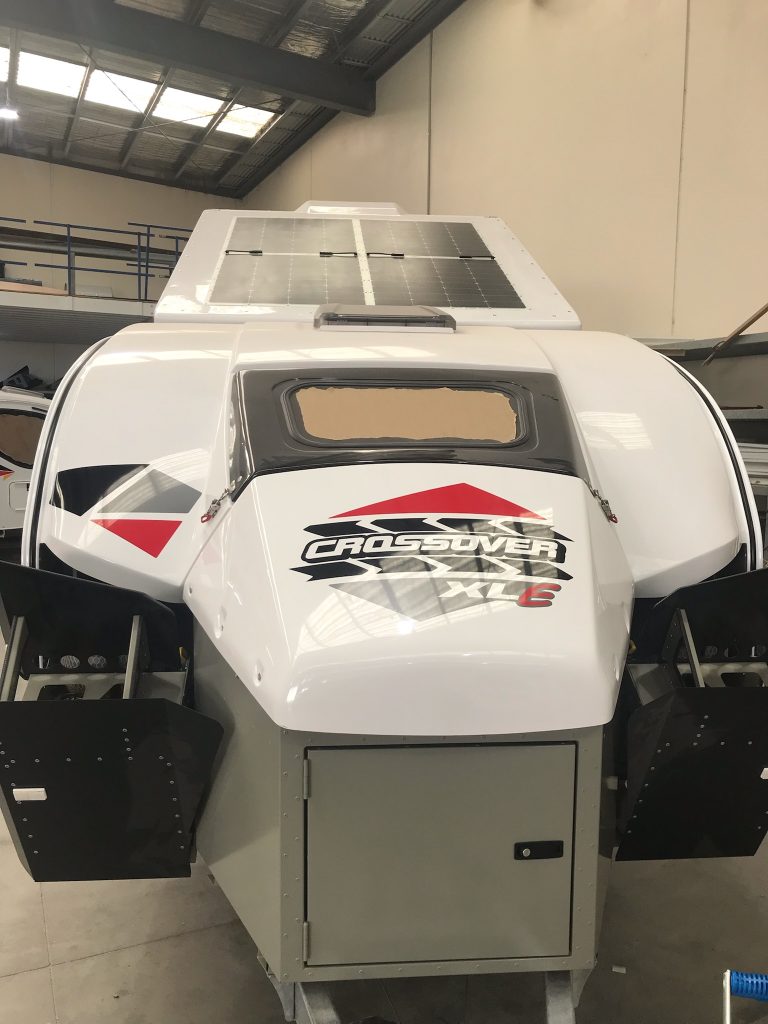
The Doc’s new hybrid offroad caravan is nearly ready – just a shelf to be made and installed. Photos were supplied today of the van.

Electrics controlled by a REDARC TVMS with the REDARC Rogue added on for more circuits. 645W of solar panels, 400Ah of Lithium batteries and a 3000W REDARC Black Alpha inverter. It has the air suspension option as well. Tyres match the Grenadier, BF Goodridge KO2’s. Plus red go fast stickers. External kitchen with a small internal kitchen. Fridge can be used internally and externally (it is on draw).

The model name XLE signifies external fridge, verse XLI for internal fridge.

The Doc will install his JOOCLA Shower into the van.

Enjoy (The Doc is!).

Battery Monitor Review 12 month update

The BLE Battery Monitor was reviewed here.

All three BLE battery monitors have now been working for 12 months, monitoring two AGM batteries and now one Lithium battery. All are still working. The original review stands after 12 months.

Parasitic drain

The BLE battery monitor does have a parasitic drain on the battery which cannot be picked up by the Battery Management System on The Doc’s Invicta 125 Ah lithium battery. So the battery can be slowly drained over time with the BMS still showing a 100% charge. It seems the draw of the BLE and the BMS itself are too small for the BMS to monitor.

BLE App being updated

The BLE App has been updated probably three times over the year. Minimal features upgraded, but good it is to see regular maintenance updates.

Lithium battery issues

The BLE is not designed to be used on Lithium batteries, so it does not properly monitor the charge, as a Lithium battery has a different voltage profile to an AGM. The BMS has a Bluetooth module that communicates to the Invicta’s App, giving The Doc all the details about the battery. The BLE allows The Doc to see what happens over 30 days and graphs that data. UPDATE: BLE has released a Lithium version of the battery monitor.

Conclusion

Money well spent.

Automotive 12 volt guides

The Doc has put his 12 volt guides together on Anderson plugs, crimping and fuses. You can go to this page here, or choose Nissan Patrol on the Menu above and go to Automotive 12 volt and the articles will appear on the right side.

12 volt car fuses–buy quality fuses–avoid Cheap Chinese Crap

In short, Cheap Chinese Crap (CCC) blade fuses are unsafe to use.

Just like Anderson plugs, which The Doc discussed here, blade fuses have been overrun by Cheap Chinese Crap. Avoid buying Cheap Chinese Crap, it can be a matter of life and death.

CCC blade fuses are commonly sold on eBay and Amazon. There is a reason why they sell fuses for a few cents each and quality fuses can cost a $1 or more. CCC fuses do not work properly, and they pose a real danger to those who use them. They are unsafe to use.

Fuses, to be safe and effective, need to be built to a specification and certified to perform in accordance with that specification. Cheap Chinese Crap doesn’t. In the case of a catastrophic fuse failure your car can catch fire and be burnt to the ground or you can be injured/killed or have your expensive equipment destroyed. While catastrophic failures are rare, you do not want to be the unlucky one, when it can be avoided.

Saving a few dollars buying CCC fuses is not worth it. If a CCC fuse damages a car’s wiring loom, the repair bill can run into 1,000s of dollars.

Problems created by CCC fuses

Poorly made fuses can have one of more of the following problems:

  1. incorrect manufacturing tolerances, so the fuse does not fit properly in the fuse holder. Poor contacts can mean your device will not work or it create shorts, and in worse cases scenarios fires;
  2. not meeting the rated performance specification. For example, a fuse rated at 5 amps does not blow until 12.5 amps; way beyond the specification, risking fire and damage/destruction of the device the fuse is supposed to protect. Here is an eye opening video, where CCC fuses do not work as rated: https://youtu.be/bVKuYOA3F2E
  3. use of inferior materials, meaning the CCC fuses may melt and catch fire. Another eye opening video here were CCC fuses, when they blow, often melt the plastic fuse cover: https://youtu.be/tDuJx1qciBg

Both videos show how dangerous these CCC fuses can be. Minimise your risks, avoid Cheap Chinese Crap.

What to buy

Buy fuses which are certified to perform to specification and have a rating marked in white on the back of the fuse (5, 7.5, 10, 15, 20 amps, etc). So only buy fuses with the white rating from a reliable dealer. Do not use fuses which do not have the rating painted in white. All the fuses in The Doc’s car have these rated the fuses from factory. Car makers understand the importance of rated fuses and use high quality fuses when making the car. You should do the same.

Quality rated fuses are made by LittleFuse, PEC, Jeng Feng (Taiwan), Bussmann (who source from PEC and JF) or Prolec. The Doc buys his fuses online from Swe-Check, a fuse specialist. Quality fuses normally come with a specification sheet.

The Doc was not always so informed and has wasted money on CCC fuses (now happily thrown in the garbage, with a lesson learned). This post is to stop you making the same mistake. While this post concerns blade fuses in cars, the main points apply to other CCC fuses. Avoid them.

Tip: all components in a car’s 12 volt electrical system should be good quality, Australian made copper wire, tin-plated copper (not brass) crimp terminals, genuine Anderson plugs (not Anderson style plugs), quality certified fuses (not CCC), etc.

Even more information here and here.

Aussie made 11 to 15

4X4 Equipment

Aussie Made No 11: Enerdive are based in Queensland. While some products are sourced from overseas, Enerdrive does manufacture its own range of ePOWER AC battery chargers & DC2DC battery chargers along with their Lithium battery systems: https://enerdrive.com.au/

Aussie Made No 12: Austech Wire & Cable make copper cables for automotive, marine, speakers, irrigation, etc.  Automotive cables are sold at retail under the name Owl or Wise Owl on eBay: https://austechwire.com.au/#about

Aussie Made No 13: Tycab Australia’s cable products are used across a broad range of industries, from Automotive, Irrigation, Building, Data & Instrumentation to Security, Marine, Welding, Speaker & Audio and Switchboards. I have used their automotive cables and they are world class: https://www.tycab.com.au/

Aussie Made No 14: SmartBar was the original lightweight plastic bullbar built to absorb an impact and bounce back into shape. They are much more pedestrian friendly in an accident. I have one installed on the Patrol. There is a variety of bars now called SmartBar, StealthBar and SpartanBar: https://smartbar.com.au/

Aussie Made No 15: Rhino Rack makes a vast array of roof racks and accessories right here in Australia. The Patrol has a Pioneer Platform fitted with jerry can holder and spare tyre carrier: https://www.rhinorack.com.au/en-au

Better battery terminals

Unilug

The Patrol has a starter battery (obviously) and auxiliary battery under the bonnet. When it was set up the wiring were well organised. Over the years as things were added it began to look like spaghetti, especially some of the smaller terminals connected to gauges and monitors. The Doc could have had it all rewired through a fuse box or busbar but he looked for a more cost-effective DYI solution.

He found the Unilug, an Australian designed battery terminal (unfortunately not made in Australia).

Unilug

The Unilug attaches to the standard battery post, but then gives you two configurable terminals. It is well made and versatile. You can use it in the two bolt configuration or you can have one standard terminal battery post and one bolt.

The standard battery post just screws onto the bolt, there is a second nut allowing you to configure a two-bolt setup. You can use a wrench on the top of the battery post to tighten or loosen the post. You can see the cutaways in the image.

The “nut” and bolt used to attach the Unilug to the original battery post is easy to loosen and tighten, as the “nut” is counter sunk into the Unilug – someone thought about the design.

The Doc installed the Unilug on both batteries and tidied all the wiring up. It allows you to put heavier cables on one terminal and the smaller ones on the second. Avoiding the smaller terminals being crushed or bent as you tighten to secure the heavier cables.

Pricing does vary but The Doc has bought them for $49 for a pair including postage (negative and positive). The only difference between the two terminals is the colour of the plastic insulation cover, the underlying terminals are identical. A small screw is used to attach the insulation to the Unilug.

The Doc also carries one Unilug in his spares kit.

The Doc had a similar issue with the battery box between the large and small terminals attaching to the battery posts. When you tighten the bolt to secure the large terminals, it can damage the smaller terminals. It is not ideal. The battery box has an AGM battery which uses a bolt configuration rather than the standard battery posts seen on car batteries.

This KickAss battery terminal is typical of AGM batteries.

The bolt is tightened to hold the cables in place

Enter the Blue Sea Systems Terminal Mount BusBar.

Blue Sea Systems Terminal Mount BusBar

Blue Sea is a well-known name in marine circles. The Terminal Mount BusBar can be tightened down with larger terminals without any problems. The smaller terminals are then attached to the BusBar. You may have to change some of the terminals to ensure they are compatible with the BusBar. The Doc’s Crimping Guide is here.

Another very elegant solution, with built-in insulation.

Here are the technical drawings for the Blue Sea Systems Terminal Mount BusBar here.

If you need the positive terminal to be fused, buy the Blue Sea Systems ST Blade ATO/ATC Fuse Blocks instead.

Aussie made 1 to 10

Food

Aussie Made No 1: Anyone interested in good tea try Madura. It is my preferred tea brand, won over by great flavours and taste. Made here in Australia, northern NSW to be precise. It does not cost the earth and I now have several flavours to choose from. Great loyalty rewards to reduce the cost even more. Free post for orders over $50. We should support local products more: https://www.maduratea.com.au/

Aussie Made No 2: Junee Licorice and Chocolate Factory. A well loved favourite in Christmas Hampers I make up. The red licorice covered in Belgian styled coverture white chocolate is my favourite, followed by milk chocolate red licorice and the Sun Muscat grapes in Dark Chocolate: https://www.greengroveorganics.com.au/the-junee-licorice-and-chocolate-factory/

Aussie Made No 3: Random Harvest Gourmet mustards, sauces and chutneys are some of my favourites. More expensive than some other brands but a wonderful indulgence at Christmas or Easter: https://randomharvestgourmet.com.au/#about

4X4 Equipment

Aussie Made No 4: moving from food to manufactured equipment today. REDARC Australia makes a range of items for the 4×4 market like DC to DC chargers, battery management systems, solar blankets, inverters and gauges. The Doc has a REDARC DC to DC charger and Autron gauges in the Patrol. REDARC bought Autron and relabelled the gauges as REDARC. They make quality goods than can withstand the harsh Outback. Equipment costs more but last, so it costs less in the long run: https://www.redarc.com.au/

Aussie Made No 5: few will have heard of this name, unless you are a caravaner. BMPRO, based in Victoria, makes battery chargers and battery management systems for caravans, RVs and 4X4s. The name is new to me. It was a BMPro MiniboostPro DC to DC charger with solar input I got installed in the Battery Box. The unit is not waterproof, so you cannot install it under the car bonnet, but inside the car or battery box is fine. Made here in Australia, costing less than the REDARC equivalents: https://teambmpro.com/

Aussie Made No 6: interVOLT, based in Western Australia, makes DC-DC Power Conditioners, Battery Equalisers, Voltage Stabilisers and Lighting Dimmers. Their target market was marine use but I had an interVOLT EBI Pro installed in the Patrol. It was a programmable solid-state dual battery controller used to charge the auxiliary battery (recently replaced by the REDARC with a solar input): http://www.intervolt.com/news/

Aussie Made No 7: GME makes UHF radios, aerials, Personal Locator Beacons, etc. all of which I have. I have two GME UHF’s, two aerials and two PLBs. Excellent build quality, great features and good after sales service (had an LED light fixed, UHF was still working). I do not understand why people buy other brands when GME are a world leader in UHF and PBLs. They have never let me down. They have both land and marine versions of their products: https://www.gme.net.au/gme-au

Aussie Made No 8: RFI aerials. Used by many emergency service vehicles in Australia. They have a vast selection of UHF, VHF and mobile aerials. The RFI aerial is attached to one of the GME UHF units (I have two for safety reasons – after a near miss). It works really well: https://www.rfiwireless.com.au/mobile-products.html

Aussie Made No 9: Water in diesel alarm. Winner of the Inventor of the Year Award. It monitors in real time diesel use and sounds an alarm if any water is found in contaminated fuel, allowing you to shut down the engine and drain the water before your engine is damaged. Can be used in cars, boats and generators, it is installed on the Patrol: https://www.waterindiesel.com.au/shop

Aussie Made No 10: LightFORCE makes driving lights, LED bars and spotlights for the world market. The Patrol has two Genesis HID driving lights fitted and a small LED light bar on the rear for light at night. LightFORCE is renowned the world over, a few days ago I saw a set of lights fitted to avalanche clearance plant and equipment in Alaska: https://www.lightforce.com/AUS/

Aussie made 11 to 15 here.

Aussie made 16 to 20 here.