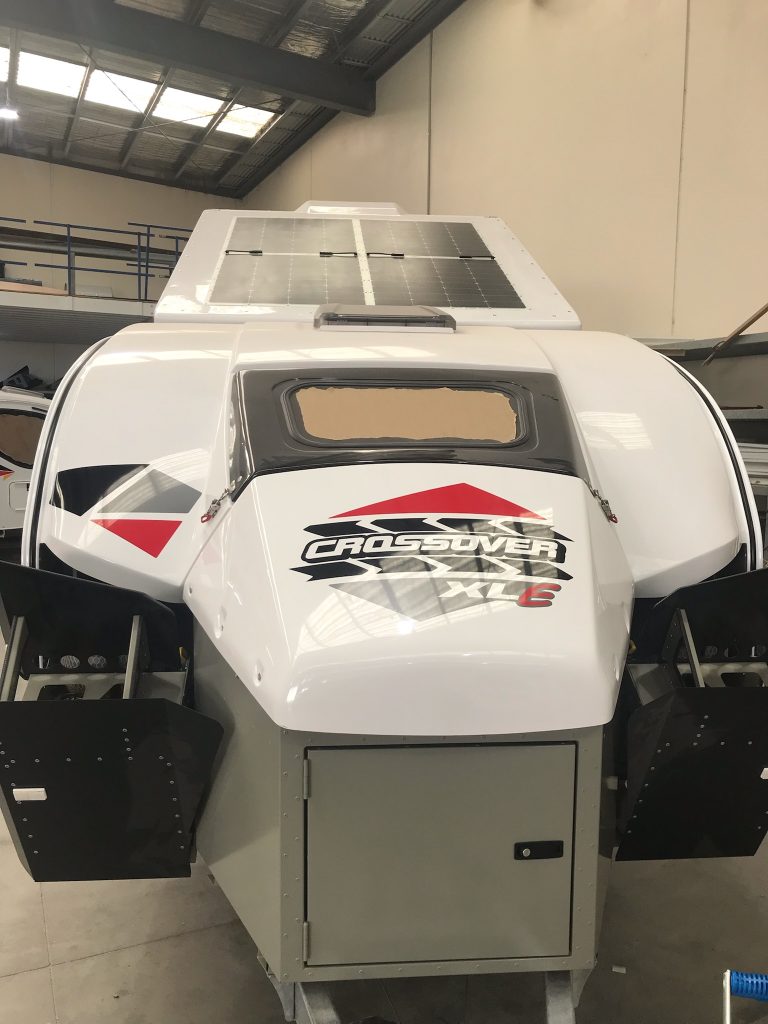
Vista RV Crossover XLE

The Doc’s new hybrid offroad caravan is nearly ready – just a shelf to be made and installed. Photos were supplied today of the van.

Electrics controlled by a REDARC TVMS with the REDARC Rogue added on for more circuits. 645W of solar panels, 400Ah of Lithium batteries and a 3000W REDARC Black Alpha inverter. It has the air suspension option as well. Tyres match the Grenadier, BF Goodridge KO2’s. Plus red go fast stickers. External kitchen with a small internal kitchen. Fridge can be used internally and externally (it is on draw).

The model name XLE signifies external fridge, verse XLI for internal fridge.

The Doc will install his JOOCLA Shower into the van.

Enjoy (The Doc is!).

Derby mud flats

The massive tidal changes in King Sound reveals extensive mud flats across the southern part of the Sound, around Derby.

Derby township itself is surrounded by mud flats which The Doc drove on several times (being careful not to break through the dried surface). These mud flats are not fully tidal every day, probably only on King tides. However, anytime The Doc felt the surface get soft he headed back to drier parts.

After taking off, in the helicopter, the first place we see is the big house, the Derby Prison. The Prison inmates look after the graves at the nearby Leper Colony, aka the old Bungarun Leprosarium, just north of Derby (Blog report here). The Doc drove up to Bungarun using the mud flats, not the road.

The mud flats reveal one of nature’s fractals, the repeating patterns you see when water is draining away on the mud flats (what The Doc calls the recurring tree pattern). To be precise “Fractals are infinitely complex patterns that are self-similar across different scales.” If you look carefully, you will see the same pattern repeating itself. Admittedly it is more obvious in the helicopter where you better appreciate the scale of these fractals.

There is endless variety in the mud flats, including their shapes, colour and textures. While they are many images, the total was culled hard to give a good cross section.

The Doc finds the mud flats fascinating. Enjoy.

The Buccaneer Archipelago, with a little of Yampi Sound thrown in

Below is a satellite image of Derby, King Sound (that great big “harbour”) and on its northern edge a group of Islands known as the Buccaneer Archipelago. The Derby mud flats are obvious on the southern edge of King Sound, near the Derby township. Towards the top right is the Walcott Inlet, which leads into Charnley River and its gorge, yesterdays spectacular post.

The helicopter trip continues. Here is small selection of images from the Buccaneer Archipelago. Wikipedia states “The archipelago, covering over 50 square kilometres (19 sq mi) is located at the head of King Sound and is composed of about 800 islands found between King Sound and Collier Bay near Yampi Sound.”

Yampi Sound also has a major Army training base inland from the Sound itself. The images towards the middle with a burn off taking place, from memory, is part of Yampi training grounds. Often Yampi is boring open grasslands. The Australian Wildlife Conservancy helps the Army conserve part of the training grounds set aside for conservation along the coast.

The massive tidal flows are obvious in several images, with the disturbed water during a tidal change.

To see a larger image click on a thumbnail.

Charnley River Gorge, Artesian Range, The Kimberley

When posting some Kimberley images recently The Doc realised he has not posted images from his 2-day helicopter trip out of Derby in 2015 (better late than never!) – except 2 or 3 images.

Starting with Day 2, here are images from flying along the Charnley River Gorge, Artesian Range, The Kimberley, Western Australia. It was a thrill of a lifetime, breathtakingly beautiful place. We had permission from Australian Wildlife Conservancy to do the trip over their property and land. With both the pilot and the passenger being AWC supporters helps!

The Artesian Range is the only part of Australia that has not suffered any mammal extinctions since European settlement, but the cane toads got into the area in the last few years. So that may change.

Where the river bed is a muddy light grey, the river is tidal. The clearer water is beyond the tidal zone and is fresh water coming down the river.

We landed and took pictures of Aboriginal art, which had some very rare figures. The Doc may post one or two later.

Make sure you click on the image to see the full size slide show.

Grenadier button pusher

The Doc always turns off the Stop/Start function on the Grenadier. This must be done each time you start the car, unless you get the Grenadier USA Button Pusher which does that for you. One of the most useful accessories fitted. Starting is so much easier, much more than The Doc was expecting. Expensive but worth every cent for the time saved. The Doc bought red, the fastest colour. 😉

Eromanga & Outback Queensland – St George, Dirranbandi, Goondawindi – the trip ends

The Doc drove straight from Stanthorpe to Eromanga, with an overnight stay at Cunnamulla. The return trip was over a week, starting with an alternate route out of Eromanga. Two nights were spent at St George where The Doc went exploring especially around Dirranbandi, which a mate raves about. Driving down the Castlereagh Highway south out of St George was nice but terrifying anytime a roadtrain came the other way on this narrow road. Dirranbandi is a road hub with heavy roadtrain traffic. Uninspiring so far.

The Doc refueled, took a rest, visited the bakery, and headed back a different way using the Whyenbah Road. A road that services stations and farms. Suddenly the mood changed and became a magical road trip, almost no traffic, beautiful afternoon light, storm clouds and great scenery. The road is not fully sealed, but is slowly being sealed. You rejoin the Balonne Highway just west of the St George Township. The Doc needs to get the exact location of the riverside stop his mate uses and drive on the Whyenbah Road, not the Castlereagh Highway, when heading to Dirranbandi.

Next stop Goondawindi and Boggabilla. There was some local exploring but the main purpose was to visit the Goondawindi Botanic Gardens (Botanic Gardens of the Western Woodlands). A few nights there and then back to Ballina. More time is needed to cover the extensive Botanic Gardens grounds but here are images from the visit:

Most topics are now done. My favourite image of the trip? Peglers Pond at sunrise.

Priestly Spiny Orbweaver – Outback Queensland

After leaving Eromanga the first overnight stop was St George at the Balonne Inn. The Doc stayed there two nights and went to visit Alton National Park for a day visit. While there he photographed an unknown spider. The Doc has finally identified it as a Priestly Spiny Orbweaver (Gasteracantha sacerdotalis). This sighting is over 400 kilometers west of any other sighting of this species, as most sightings are along the Queensland Coast.

Leaving Eromanga – alternate routes

Leaving Eromanga around 4am The Doc headed towards Quilpie; on the western side of Quilpie he turned right onto the Quilpie-Thargomindah Road and headed south towards Toompine. South of Toompine he turned left on the Eulo-Toompine Road and headed towards the Adventure Way and Eulo (he also had morning tea at this road junction). It was a really nice drive along both these roads. The route is on the linked map here. The pictures are from this small part of the trip.

While driving along Eulo-Toompine Road The Doc saw three caravans just off the road, one was being towed by an Eldoret Blue Grenadier (there was no time to stop and talk as there was a long drive ahead). When the Doc reached the corner of the Eulo-Toompine Road and the Adventure Way two large SLRV vehicles (MAN Commanders) were traveling west were talking about the baby SLRV on the UHF (The Doc’s Grenadier). Both events happened in about 30 minutes in the middle of nowhere.

The rest of the trip to Goondiwindi (actually nearby Bogabilla) was the same route as the trip in.

Shakedown lessons
Cunnamulla would be the refueling stop, but the grey nomads were everywhere, especially lined up for fuel. There was still fuel in the Grenadier’s mounted fuel containers. The Doc pulled out the fuel pump to find out the diameter of the tank opening did not let the pump be inserted. The Doc decided to refuel at Bollom instead and arrived on fuel vapors (with one or two litres left in the car).

The fuel tank was fixed at Expedition HQ during the next service, by reboring the opening. It turns out when the tanks were purchased, The Doc was given the wrong set of fuel tanks. This is why The Doc does shake down trips to find things like this out without creating major dramas.

The Doc also found out on the trip he could not sleep in the Grenadier due to his ongoing injuries from the car accident and instead had to stay in a motel. Before setting out The Doc thought he could sleep in the car, but he got a reality check instead! It became obvious on this trip The Doc needed extensive rehab and he started heading back home for treatment. The car was not only being tested but also the driver under field conditions. It was a wake up – and the intense rehab is still ongoing.

The Lightforce Viper lightbar also prove itself in the dark and rain driving out of Eromanga.

Cunnamulla, Eulo, Thargomindah – Outback Queensland

After leaving Stanthorpe, The Doc travelled along the Stanthorpe-Texas Road. Then through Texas and heading northward to Inglewood (along the Inglewood-Texas Road), which was a great drive early in the morning. Time to visit the local bakery and get some warm bacon and cheese topped rolls, which was the food for the day (nice rolls they were). The last roll later in the day was warmed up in the Travel Buddy Oven.

The Doc drove all day and stayed overnight at Cunnamulla. It was a long day’s driving. On the way The Doc fueled at a Roadhouse outside Goondawindi. From memory, it was time for a Magnum ice cream.

Leaving Cunnamulla early the next morning The Doc travelled west out of Cunnamulla via Eulo (Eu-lo) and Thargomindah (Thar-go-min-dah) along the Bulloo Developmental Road. Here is an interactive map of the trip from Ballina to Eromanga.

Eulo is a place where many of the Australian Megafauna, like the Diprotodon, are found.

Previously The Doc had always travelled north out of Cunnamulla along the Mitchell Highway, but a change was in order.

The Doc visited Noccundra and then turned northwards onto the Cooper Developmental Road and up into Eromanga the back way.

The traffic was light all the way. It turns out had The Doc gone the normal way (Cunnamulla, Charleville, Quilpie and then Eromanga) he would have run into many cars heading to the Big Red Bash at Birdsville.

On a back road, The Doc came across a little oasis in the in the middle of nowhere in this semi arid landscape. Enjoy.