The original Shady Lady is red like many waratahs. In this image you have three flowers in different stages of development, the bud, emerging flower from the bud and the fully formed flower, but not yet fully open. Single image, flash diffuser used.

The original Shady Lady is red like many waratahs. In this image you have three flowers in different stages of development, the bud, emerging flower from the bud and the fully formed flower, but not yet fully open. Single image, flash diffuser used.
Telopea is more commonly known as the Waratah family, floral emblem of NSW.
Older white flower dying with new flower emerging from bottom left.
For camera nerds: RAW conversion using DXO PureRaw2, simple levels adjustment only, background darkened, then sharpened in Topaz Sharpen AI. Single image, using Godox V350o flash with Cynustech diffuser on Panasonic G9 with Panasonic 30mm macro lens, handheld.

The Doc could not find a common name for this variety of wattle. It is beginning to flower in the middle of winter at Mt Annan Botanic Gardens.

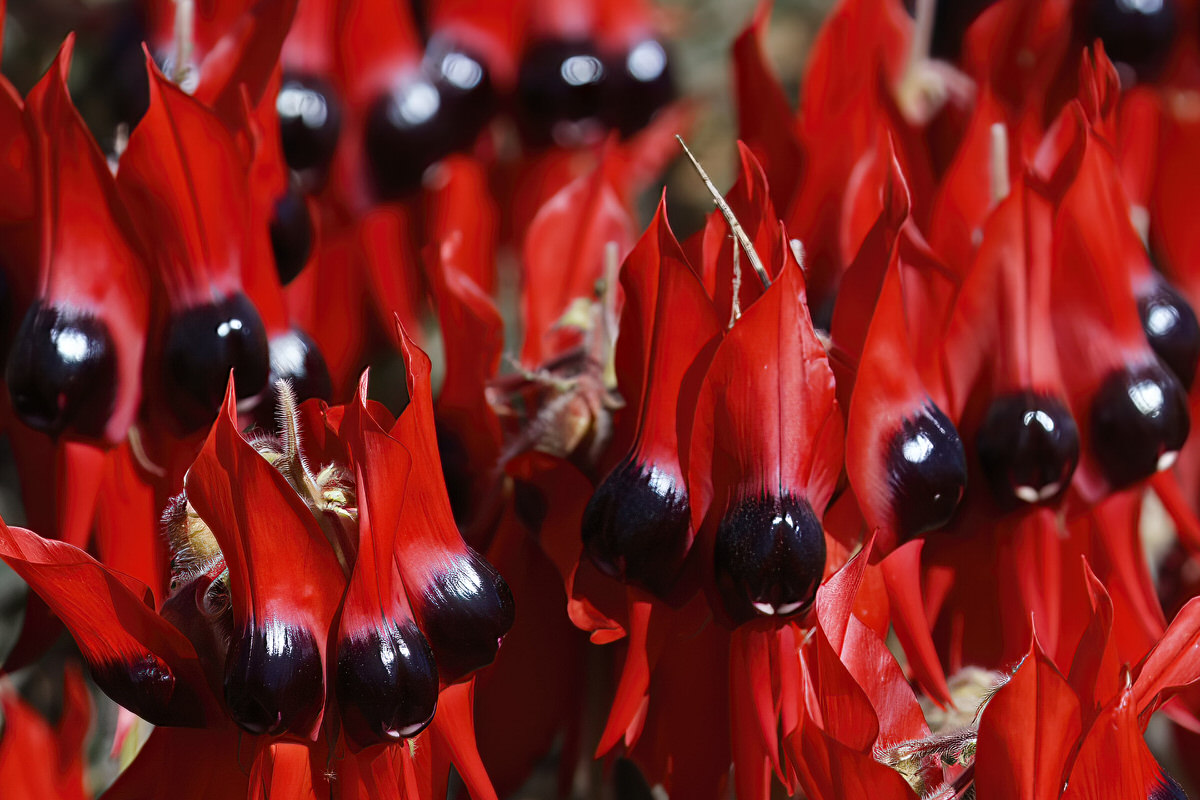
Commonly known as the Sturt Desert Pea, floral emblem of South Australia. The dark eye version is from South Australia, the lighter coloured eye is the northern or WA form found in the Northern Territory and WA.
It is known by some other names as well including: Swainsona formosa, Showy Donia (G. Don 1832), Beautiful Donia (G. Don 1832), Dampier’s clianth (Veitch 1850), Dampier’s Clianthus (Hooker 1858), Sturt’s pea (Adelaide Advertiser 1858), Sturt pea (de Mole 1861), Captain Sturt’s desert pea (Aspinall 1862), Desert pea (Anon 1864), Sturt’s desert pea (Tenison-Woods 1865), Glory flower (Bailey 1883), Glory pea (Bailey 1883), Sturt’s glory pea (Anon 1886), Lobster claws (The Garden 1890), Blood flower (Parker 1898), Dampier’s glory pea (Guilfoyle 1911), Australian glory pea (Guilfoyle 1911), Dampier pea (Harris 1980).




Creating the colour palettes for the barks, flowers and leaves has been an eye opener. Take Banksia blechnifolia, which The Doc thought was a fairly bland flower, at least as Banksias go. Here is the image:

At first glance it suggests a bland colour palette, until you analyse the palette. Here are the ten most dominant colours including Rose Gold, Big Dip O’Ruby and Turkish Rose:

Further analysis shows 178,775 total colours, comprising 179 core colours. And The Doc was thinking there was two main colours, white and rose-pink.


As you know The Doc have been doing macro works involving mostly barks, leaves and seeds. The work has been uploaded to the Atlas of Living Australia run by the CSIRO.
The Doc’s work was noticed and The Doc was one of three people featured in an ALA Blog article a little while ago. Look under Stunning close ups, here.
May the peace of the Christ child be with you and your family this Christmas.
Not much travel after the recent death on my father. The Doc did manage to visit another AWC Sanctuary, this time Curramore. He will post a few photos in the near future.
He is also thinking of Tasmania next year, a nice change from the red dust.
In the meantime, another flower following a recent theme. This time with a white background. Instead of using the inverse square law giving a black background, here The Doc used translucent Perspex as the background. He fired the second flash through the Perspex to overexpose the background, making it white. The Doc used the main flash to expose the front of the flower. It is a focus stack of 6 images.

Some flowers from my Mother’s 80th birthday party and the coastal banksia heath near Lennox Head. Enjoy.


As part of the his macro work The Doc is learning how to better use his flash, both on and off the camera. He did a little bit of macro on the Northern Territory trip, but the wind did not help. So more needs to be learned about off camera flash (which copes with wind much better and gives better results).
While at Ballina The Doc is also buying a basic off-camera kit like lightstands, triggers, adapters and flash cold shoes. He has spent several days reading, rereading and watching videos, when he is not painting his parents balcony. Up to coat 5 so far!Lets not forget about washing cars as well.
As part of his research he needed to learn about lightstand adapters and cold shoes. Here is the background research on the adapters and cold shoes.


The Doc has spent the last 2 days out on tours, to Sweets Lagoon and Corroboree Billabong (Mary River Floodplain). The Patrol had been serviced and it was time to see the wetlands by plane and boat (to avoid the mud and crocs by doing it on land).
On paper, Outback Floatplanes Adventures trip to Sweet Lagoon looked the better option. It had a floatplane flight, airboat (flat bottom boat driven by a V8 using a propeller), helicopter flight and cruise in a flat bottom boat.
Corroboree Billabong was the Wildlands Ultimate Tour consisting of an airboat and flat bottom boat tour. The BBC has filmed twice here. This billabong has the highest concentration of crocs in the world. The billabong is fed by the massive Mary River Floodplain. The wildlife has to be be seen to be believed. Thousands and thousands of birds, fish a plenty and lots of top line predators like crocs and White Bellied Sea Eagles. The Doc even got to eat some bush tucker from the Sacred Lotus Lily and another flower.
Hands down Corroboree Billabong was better and around 1/3 the cost of the Outback Floatplanes Adventure. Sweet lagoon was expensive at $800 [2017] for what it was, a little bit of the four things from around 8.30am to midday. They even charge a credit fee of 1.5%, unlike Wildlands. As an experienced Outback Traveller The Doc would not do it again, but would return to Corroboree Billabong in a heart beat, and that cost only $240 for both.
The Doc was left with the feeling Sweet Lagoon was all about maximising bums on seats and putting the tourist thorough the production line. This is the first time The Doc felt this on his trips. It was not the people, but the production line process.
The auxiliary battery in the Patrol failed on Saturday morning so The Doc has extended his stay in Darwin 2 days to wait for the replacement. A bit lucky the battery failed while the The Doc was in Darwin rather than in the Outback. The Doc has never seen a battery fail so fast, almost no warning signs (The Doc knew there was an issue Friday, but Saturday morning confirmed the failure). The demands of the hot weather was too much.
This is a sample of the floodplain in and around Mary River and Kakadu.


Corroboree Billbong, water, flowers crocs and birds, all in abundance.


Sweets Lagoon images.


You must be logged in to post a comment.