Tag Archives: fitout

Grenadier build – metal number plate holder installed

The Doc has never been happy with the front plastic number plate holder. Black Sheep now sell a metal version which The Doc installed today.

Here are some of the lessons learned.

BLACK SHEEP NUMBER PLATE HOLDER INSTALLATION HELP
The Doc could not get all four bolts into the bumper bar, there was always one hole misaligned, despite trying a few things. Not sure if it is a design issue with the Black Sheep holder or a manufacturing variation in The Doc’s car. The Doc used the top two bolt holes and the bottom right side. The Black Sheep holder is secure and a lot stronger than the old INEOS plastic number plate holder (INEOS holder). The missing bolt is not visible with the Black Sheep holder cover down.

The holder appears level on the bumper bar.

Make sure the top of the holder is properly aligned with the bumper, otherwise you can have issues inserting the new bolts.

TOOLS NEEDED

  1. Screw driver to remove the screws holding the number plate onto the INEOS holder.
  2. Torx T30 bit/tool to remove the four bolts securing the INEOS holder. All four bolts were not tight on my car, but they did appear to have some sort of loctite on the bolts.
  3. A 10mm bit used to tighten the bolts supplied with the Black Sheep holder (they have hex heads and a washer, they are not Torx T30 bolts). You cannot reuse the T30 bolts removed earlier due to their head shape.

PARTS NEEDED

  1. You must source two bolts used to attach the number plate to the Black Sheep holder (instead of the screws which do not work with the Black Sheep holder). The Doc used bolts with a 8mm hex head. These bolts go into different holes on the number plate (compared to the screws), The Doc just aligned the number plate on the Black Sheep holder to see what bolt holes to use.
  2. The Doc used marine Goop on all the bolts and the black plastic covers for the visible bolts (hiding the silver bolt heads and nuts). Over time these black plastic covers are likely to fall off, even with the Marine Goop.

There were rain showers during the install. The number plate is a standard size NSW plate, not a custom size.

Grenadier build- Outback shakedown changes – Round 3

Recently the Australian Wildlife Conservancy stickers went on the car. The Doc found himself smiling when driving back home, as the build is now mostly complete. The first time The Doc can remember being so happy since the fatal car accident 2 years ago. The Grenadier build has been therapeutic! The Doc is still working through injuries and trauma but starting to feel better.

The car is back to being AWC’s mobile billboard and ready for The Doc’s Excellent Adventure.

The L tracks did make fitting the stickers more challenging. Fonts had to follow AWC’s guidelines, except Proudly supporting.

Observant readers will have noticed the car’s name is now official: Wally. Named after the wallaby The Doc hit on the road last year. The Doc added a Wally sticker to the driver’s side bonnet/hood.

Grenadier build – Outback Shakedown changes – Round 2

ABNTR4X4 Rock sliders refined
A metallic noise/rattle/squeak developed about one week after the installation of the rock sliders. Luckily before The Doc went on his Outback trip.

The sliders were attached using plates secured by bolts; some bolts were fitted through a drill hole, others through a slot in the metal plate (to allow adjustments). The bolts through the slots were trying to pull the washers through the slot, so the washer became cupped letting the rock slider move.

After the initial install the mechanic had commented the bolts should be longer. After discussing the noise problem with the mechanic, The Doc bought longer high tensile bolts (replacing the OEM galvanized bolts) and large square washers that were also thicker than the OEM washers. After jumping up and down on the sliders after the refit, the mechanic found there was still some noise. On closer inspection there were screws in the body work exposed after the trim was removed to fit the sliders. So metal was still rubbing on metal. The mechanic adjusted the position of the sliders away from the exposed screw heads.

Everything has worked well since the changes and no more issues arose in the Outback trip.

ABNTR4X4 rock sliders are great, but they needed some refinement for Australia (at least for my purposes). First, longer 50mm high tensile bolts. Second, larger and thicker square washers and lastly adjusting the sliders to avoid touching the screws exposed after the trim was removed (you could cut these screws off, but that was not my preferred option).

XHQ Molle Panels refinements – when fitted with 30l diesel tanks
When travelling on intense corrugations the XHQ Molle Panels were being vibrated, creating an annoying noise when the tanks were filled with diesel. The corrugations created a wave vibration in the Molle panel you could see in the rearview mirror. It looked like Rolf Harris was using it as a wobble board!

Additionally, two of the four washers down on the L track attachment points were not sitting flat over the Molle panel slot (sound familiar?). One washer had dug into the side of the slot on the Molle panel. I upgraded the L track bolts from M8 bolts to M10 bolts. I also used bigger and thicker washers. The upgrade has fixed the noise around the city, but no testing on corrugations so far.

Rear Bracket – passenger’s side
My dual air compressor was attached to an ORS custom bracket on the driver’s side. I decided to get a matching bracket on the passenger’s side. ORS made the bracket and covered it in marine carpet. This allows me to use canvas bags with a carpet grabber to configure what to store on the bracket.

The bracket also creates a storage area between the bracket and the rear window for storage.

Below are images of the new bracket and the carpet grabber bags I have on order. These can be easily reconfigured depending on my needs.

I also reconfigured the driver’s side storage area with my AED device, new First Aid Kit and a storage bag. The distance between the windows and brackets is slightly different between the two sides – because the plastic wheel arch trim on each side. The AED and First Aid Kit were a better fit on the driver’s side (RHD).

Grenadier build – Outback Shakedown changes – Round 1

The Doc learnt a few lessons after his Outback trip last year. Here is the first installment, with two more to follow.

New canvas bags on front doors
Added some canvas door pockets on both sides under the speaker to store my driving gloves and handwipes – these items kept falling out of the main door pocket. The pocket does not touch my leg when driving.

Dry bag driver’s side pocket
The Doc bought a 2 litre dry bag and put his diesel funnel and gloves he used to fuel the car into it – to stop the diesel smell when they were not in use. Works a treat, and the dry bag stops the other items falling out of or rattling in the driver’s side OEM door pocket.

Access whole in cargo barrier
The Doc cut an access hole in the cargo barrier and lined it. I can crawl into the back between the front seats onto the bed (like I did in the Patrol). The Doc can also access items through the opening. A net can cover the space if needed.

Seat organisers on cargo barrier
DRIFTA Stockton seat organisers have been installed on the cargo barrier behind the both front seats. It is great place to store bits and pieces like torches, batteries, tie downs and even a tea flask and cup. The Doc bought the dual pack and the organisers are different in their pocket configuration. The organisers are really useful and allow storage in an unused area. The Doc had to remove one fire extinguisher from the barrier behind the passenger seat, but the extinguisher fits nicely into the organiser – win/win.

Canvas bag for cutlery under picnic table
The Doc needed a small cutlery set when he stopped and had a quick wrap on the INEOS picnic table. Instead of getting out the full cutlery set, The Doc bought a Get Good Gear MOLLE Pouch – Utility Bag and mounted it under the picnic table. It just makes life quicker and easier if he is driving long distances. The bag is easy to remove when not traveling. The complete cutlery kit is there when needed. The bag is thin enough so it does not touch the ORS Drawer handles. After the image was taken a small pocket knife was mounted next to the Molle Bag.

DRIFTA recovery shovel and dunny shovel
The Doc’s old shovel is an odd shape and on the heavy side. It was taking up too much inside the car and causing wasted storage area. The Doc bought a new Recovery shovel and a Dunny shovel, from DRIFTA. They are lighter and more compact, plus they fit into an unused space The Doc has been trying to use between the bed extension foot and the cargo barrier. Freeing up space under the bed extension to be used more effectively. The Dunny shovel (first image) can be stored with the Recovery shovel (second image), if needed.

Grenadier build – CAT Electronic Rust Protection Systems – 12 month review


It has been almost 12 months since The Doc installed the CAT Electronic Rust Protection Systems into the Grenadier, using 6 pads around the car (over the rear wheel arches, two in the battery box and in both front footwells). This is not a technical report but some field observations.

In that time, The Doc has taken the car remotely to outback Queensland, had the car directly exposed to salt air, when staying by the seaside for a few weeks. Plus, plenty of rain. The CAT system has a minimal power drain on the batteries and it seems to be working. The Grenadier has almost no rust at all. No rusty wheel studs, almost nothing under the car and no rust anywhere else.

Wally being exposed to salt air.

Grenadier build – carpet grabber pouches

The carpet grabber pouches/pockets have arrived from CrazyDog Canvas. With Velcro hooks on the back, the pouches just stick to the new carpeted bracket.

Easy to reconfigure if needed.

The Doc’s Jetboil is in one pocket, the middle pocket has a lantern and USB cables (or whatever) and the other has spare gas for the Jetboil. The fourth pocket was attached to The Doc’s Bushman fridge cover to give some storage area on the back of the fridge.

Grenadier build – rock sliders

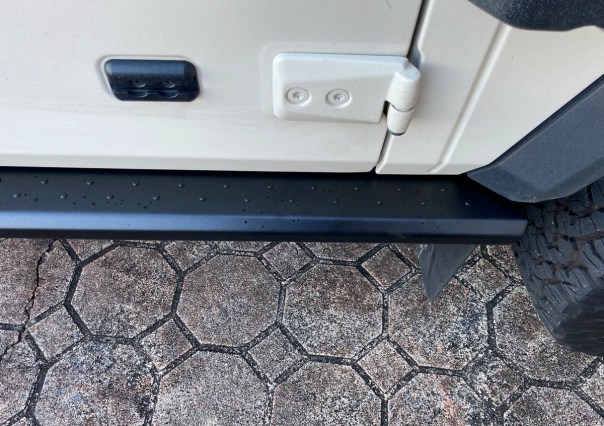
The ABNTR4X4 Rock Sliders were installed today. Very low profile these sliders. From the side they look like the standard under door trim. That mostly finishes the Grenadier build, except a few minor items.

The Doc has removed the rear diesel tanks, so you can see the XSPEC Molle better than before. They will go back on shortly. It takes roughly two minutes to remove/install each tank.

Now preparing for a remote trip to try things out, in Channel Country, Outback Queensland.

Grenadier build – 20 inch lightbar details

WHAT YOU NEED

  1. STEDI Hex brackets (choose size 48 to 53mm). The STEDI hex bracket came with a Torx Security key to tighten the bolts in the hex bracket. Not sure of the size because I could not get my Torx Security bits to fit properly. The brackets come with three M6 bolts of different sizes and types. One pair was the correct length to use in my setup. The Doc also used a Nord Lock washer and a flat washer on the M6 bolt. The Nord Lock washer ensures corrugations do not loosen the bolts.
  2. Lightforce Viper 20-inch lightbar (single or double row of LEDs). The Viper comes with side mount and slide brackets.
  3. Two standard M6 nuts. Only a standard M6 nut fitted into the hex bracket slot, a M6 Nylon Lock Nut was too thick. The hex bracket only came with Nylon Lock Nuts. See also point 1 below under FITTING.
  4. Relay, tools and wiring.
  5. The Viper had a 2 pin Deutsch DT plug attached and a wiring loom. The power came from the Grenadier’s 10 amp wire ends under the bonnet. The auto electrician changed the loom and added a relay and integrated it into the car. The Doc never saw the modified loom. The relay turns on the lights when it senses current to the high beam on your spotlights (which only work when the highbeams are on).

Laws in News South Wales and WA require lightbars to be fitted to the underside of the Roo Bar hoop, not above it. You have much more flexibility if you can mount it above the Roo Boo, but at increased risk to pedestrians.

FITTING

  1. Affix with the Lightforce slide mounts that attach to the rear of the lightbar (not the ends which use brackets – the Ligthtforce comes with both options supplied) You need to reverse the way the bolts normally insert into the hex bracket. You may need to trim the bolt’s length so it does not protrude pass the width of the bracket onto the Roo Bar. Adding two washers on the M6 bolt was enough so the bolt did not protrude, in my case. The Doc used a Nord Locker washer, flat washer and a standard M6 nut.
  2. Affix the slide brackets to the bottom half of both hex brackets. The nut must go inside the hex bracket slot, not the bolt head as normal. The image below of the slide bracket shows the correct orientation for inserting the bolt into the hex bracket.
  3. Attach the slide brackets to the lightbar. Tighten bolts onto the slide brackets, after spacing them correctly (The Doc placed then 100mm in from each end of the lightbar). Just hand tighten the bolts and check the angle of the lightbar fitted under the Roo Bar, adjust position of slide brackets if needed. You do have some additional adjustment with the way you affix the hex bracket to the Roo Bar.
  4. Attach hex brackets to the Roo Bar, check it is centered correctly. Tighten all 8 bolts in the hex brackets. TIP: when tightening the Torx Security bolts on the hex bracket, The Doc would tighten a bolt two turns and then go around and do the same to all the bolts. If you tighten one bolt too much, it can result in another becoming loose. The described approach minimised that effect.
  5. Wire up the lightbar or call ORS (Sydney based) and have then do it for you.

The Single Row Viper Lightbar lines up nicely with the grille cross support to minimise disruption to the air flow.

ANOTHER OPTION: If you do not have a winch, fitting the 20-inch Viper down on the bumper would be another option. Or if you do have a winch, be very careful about drilling holes in the bumper. The end brackets could be used for mounting in this position.